
Boating FAQs
PVC vs Hypalon for Inflatable Boats

Apr
Choosing the material for an inflatable boat usually comes down to two options: PVC (polyvinyl chloride) and Hypalon – the two main fabrics used in inflatable boat manufacturing, and the source of an ongoing debate among boaters. If you’ve wondered what inflatable boats are actually made of, the answer is almost always one of these two – everything else (the floor, the transom, the valves) is built around the tube fabric.
Here’s how the two compare, and how to choose the right one for your boating.
Advantages of PVC Inflatable Boat
- Lower initial cost: One of the most enticing aspects of a PVC inflatable boat is its affordability. PVC fabric’s production cost is generally lower, making PVC boats more accessible to a broader range of customers.
- Lighter weight: PVC boats are typically lighter, making them easier to handle and offering enhanced fuel efficiency when paired with an outboard motor.
- Easier to fold and transport: Thanks to its flexible nature, PVC fabric allows for convenient storage and transport.
- Simple repair procedures: With the right adhesive and a patch, most minor damages to PVC can be fixed easily.
- Suitability for casual and recreational use: For those seeking an inflatable boat for occasional outings or recreational purposes, PVC offers a cost-effective solution.
- Variety of colour options: PVC inflatable boat fabrics come in a wide range of colours, catering to aesthetic preferences.
Disadvantages of PVC fabric
- Lesser resistance to UV radiation: Prolonged periods of exposure to direct sunlight and UV rays can degrade PVC boats faster than Hypalon ones.
- Lower tolerance to high temperatures: PVC fabric tends to become tacky when exposed to extreme temperatures, particularly in direct sunlight.
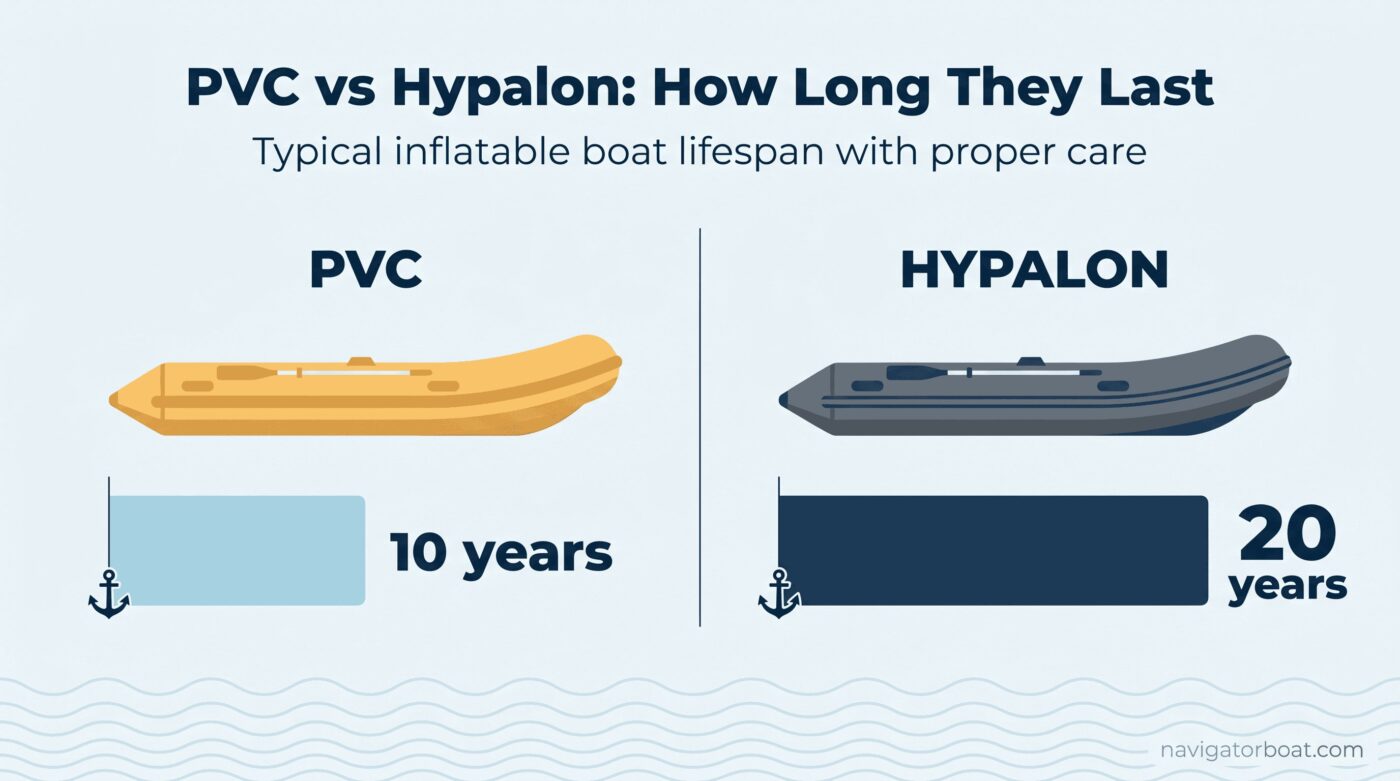
- Shorter lifespan: Generally, PVC inflatable boats have a shorter life span in comparison to Hypalon boats.
- Greater need for regular maintenance: To prolong the life of a PVC boat, regular maintenance and protection from UV rays and chemicals are crucial.
- Potential for colour fading: The vibrant colours of PVC boats can fade when exposed to prolonged direct sunlight.
Not All PVC Is Created Equal: A Note on Valmex
Buyers often assume PVC is PVC. It isn’t. The difference between budget PVC and premium PVC is bigger than most first-time owners realize, and the fabric brand on the spec sheet usually tells you which camp a boat falls into.
Valmex, made in Germany by Mehler/Vincorion, is the most respected PVC boat fabric on the market. It uses heavier-denier yarns, thicker coating layers, and tighter manufacturing tolerances than typical Asian-sourced PVC. Major European builders, including Zodiac on their PVC lines, use Valmex specifically because it closes much of the durability gap with Hypalon – at a noticeably lower price.
So when someone asks “Valmex vs Hypalon?” – the honest answer is that quality Valmex-grade PVC handles freshwater recreational use almost as well as Hypalon. The gap only widens in tropical sun, daily commercial use, or saltwater abuse, where Hypalon still pulls ahead.
When you’re comparing PVC boats, ask what fabric they use and at what denier. That single question tells you more about durability than any marketing line on the listing.
Advantages of Hypalon
- Superior durability and resistance to UV radiation: Hypalon boats are known for their impressive durability, particularly when exposed to harsh weather and UV rays.
- Suitable for both hot and cold climates: Whether under the scorching sun or in colder regions, Hypalon fabrics demonstrate consistent performance.
- Longer lifespan: With proper maintenance, a Hypalon boat can last significantly longer than its PVC counterpart.
- Lower maintenance requirements over time: While initial care is vital, Hypalon boats demand less frequent maintenance in the long run.
- Stronger resilience against abrasion and impact: The rubber and polyurethane coating of Hypalon fabric makes it more abrasion-resistant.
- Better colour retention: Hypalon retains its colours better, even after prolonged periods under the sun.
Disadvantages of Hypalon
- Higher initial cost: The superior qualities of Hypalon come at a price, making these boats more expensive upfront.
- Heavier weight: Hypalon boats tend to be heftier than PVC ones, which might be a concern for some users.
- More complex repair procedures: Repairing Hypalon requires specific solvents like methyl ethyl ketone and a more intricate process than PVC.
- Not as easily foldable for transport: The robust nature of Hypalon makes it less flexible for folding and transport.
- Limited colour options: While Hypalon boats offer excellent durability, they usually come in fewer colour options, typically dark grey and other neutral tones.
PVC vs. Hypalon Comparison Table
| Feature | PVC | Hypalon |
|---|---|---|
| Cost | Lower | Higher |
| Durability | Moderate | Superior |
| Weight | Lighter | Heavier |
| Climate Suitability | Moderate (Avoid extreme temps) | Excellent (All climates) |
| Maintenance and Repairs | Regular Maintenance Required | Less Frequent Maintenance |
| Colour Options & Retention | Vast, but can fade | Limited, but durable |
| Environmental Impact | Moderate | Lesser |
PVC and Hypalon vs Rubber Inflatables
You’ll occasionally hear “rubber boats” mentioned alongside PVC and Hypalon, especially in older boating circles. A quick clarification.
Natural rubber was the original inflatable boat material, dating back to the early 1900s. By the 1950s and 60s, it had mostly been replaced. Natural rubber degrades fast in sunlight, cracks under ozone exposure, gets brittle with age, and weighs more than its modern replacements. You’ll still find it in some pool-grade inflatables, vintage boats under restoration, and certain emergency life-raft applications – but it isn’t a serious contender for a modern recreational boat.
Here’s where it gets confusing: Hypalon is technically a synthetic rubber (chlorosulfonated polyethylene, or CSM). So when experienced boaters mention “rubber boats,” they often mean Hypalon, not natural rubber. Two completely different materials with very different lifespans.
The short version: if you’re weighing a new PVC or Hypalon boat against a natural-rubber-tube boat, modern materials win on every metric – UV resistance, weight, lifespan, repairability. Natural rubber inflatables had a good run. That run ended around the time Apollo 11 launched.
Choose Your Material with Navigator Boat
Navigator Boat understands the unique requirements of every boat enthusiast. Recognizing the distinct advantages of both PVC and Hypalon, we offer the flexibility to choose between the two materials when purchasing an inflatable boat.
So, whether you’re looking for durability, cost-effectiveness, or a boat that fits perfectly with your local climate, we at Navigator Boat ensure you sail smoothly. We always encourage our customers to tailor their boats to their specific needs, whether they prioritize durability, cost-effectiveness, or climate suitability. With Navigator Boat, you’re at the helm of your boating journey.
Navigator Inflatable Boats offers both PVC and Hypalon versions of our high-quality inflatable boats.
Browse our inflatable boat collection → to compare current PVC and Hypalon models side by side.
FAQs
Are there any environmental concerns associated with the production or disposal of PVC or Hypalon Inflatable Boats?
Both materials have environmental trade-offs. PVC is petroleum-derived and notoriously difficult to recycle – most worn-out PVC boats end up in landfill. Production has cleaned up over the last two decades, but the end-of-life problem is real.
Hypalon (chlorosulfonated polyethylene, or CSM) isn’t biodegradable either, and is similarly hard to recycle. Its environmental edge is longevity: a Hypalon boat that lasts 20 years has a smaller per-year footprint than a PVC boat replaced every 8 to 10. From a pure lifecycle standpoint, the longer-lasting material usually wins.
The greenest inflatable boat is the one you maintain well and don’t replace prematurely.
Can PVC or Hypalon boats be easily repaired in case of punctures or tears?
When it comes to repairs after punctures or tears, both materials can offer solutions that allow owners to fix their damaged boats easily. PVC repairs are quicker, cheaper, and don’t need specialty solvents – most owners can handle small punctures with a basic patch kit. Hypalon needs methyl ethyl ketone (MEK) to properly bond a patch, and the process is fussier, but a Hypalon repair done right is essentially permanent.
